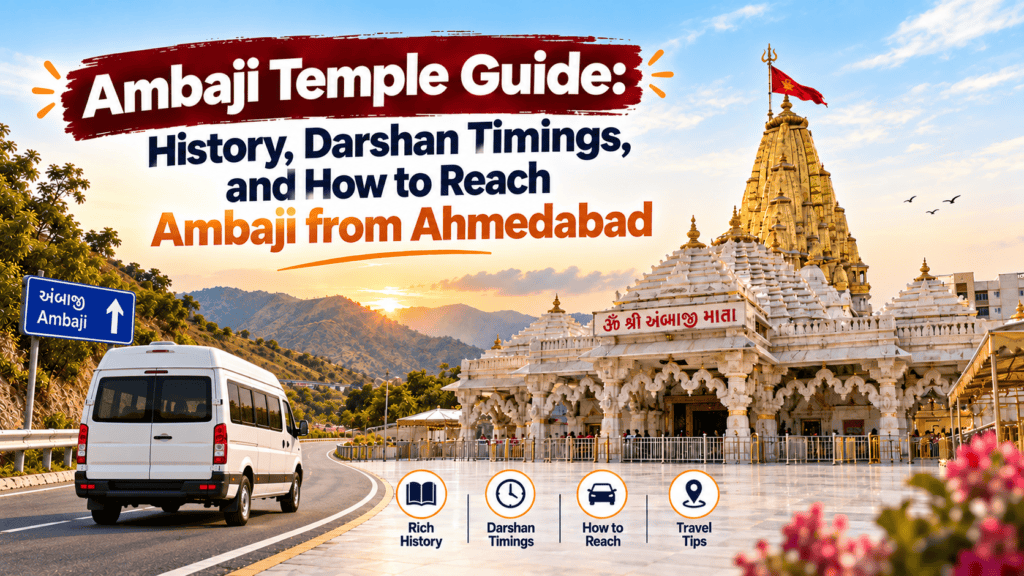
If you have ever stood in a queue at Ambaji Temple during the evening aarti, watching hundreds of lamps flicker against white marble while the whole crowd chants “Jai Ambe Maa” together, you already know why this small town in Banaskantha district pulls in millions of devotees every year. Ambaji Mata Mandir is one of Gujarat’s most visited pilgrimage sites, and for anyone planning their first Ambaji darshan, here is everything you actually need to know before you go the history of Ambaji Temple, the darshan and aarti timings, the road journey from Ahmedabad, and the small details that make the difference between a rushed day trip and a peaceful visit to Amba Maa.
Why Ambaji Temple Is So Important
Ambaji Temple is one of the 51 Shakti Peethas spread across the Indian subcontinent sacred sites believed to mark the spots where parts of Goddess Sati’s body fell after Lord Shiva carried her remains in grief. At Ambaji, tradition holds that it was her heart that fell here, which is one reason devotees consider this particular Shakti Peetha so powerful.
What surprises most first-time visitors is that there is no idol inside the sanctum. Instead of a statue, the goddess is worshipped in the form of a Shree Yantra a geometric diagram engraved with 51 alphabets representing divine energy. There are no eyes, no face, nothing to look at in the conventional sense. Photography of the yantra itself is not allowed, and many pilgrims say that this absence of a physical form is exactly what makes the darshan feel different from any other temple visit.
The Ambaji Temple itself is built almost entirely in white marble with gold-plated shikhars (spires), and it sits at the base of the Aravalli hills, right on the border where Gujarat meets Rajasthan. The main structure of this Arasuri Ambaji Mata Temple was rebuilt over the centuries, but the site’s spiritual roots go back to ancient scriptures, including references in the Ramayana it’s said that Lord Rama and Lakshman worshipped Ambaji at nearby Gabbar hill before setting out to rescue Sita. This is also why Ambaji is often called Arasuri Ambaji, and why the temple carries such deep significance among Shakti Peeth pilgrimage circuits across India.
Ambaji Temple Darshan Timings and Aarti Schedule
Ambaji Temple timings can shift slightly around festivals, so it’s always worth a quick check before you leave, but the regular Ambaji darshan timing schedule is:
- Morning darshan: 7:00 AM to 11:30 AM
- Afternoon darshan: 12:30 PM to 4:30 PM
- Evening aarti: Held after sunset, and this is genuinely the part most visitors remember the most
If your schedule allows even a small amount of flexibility, try to plan your Ambaji Temple visit around the evening aarti timing. The combination of temple bells, the marble courtyard lit up, and the collective energy of the crowd is very different from a quiet afternoon visit, and it’s the part most first-time devotees remember long after the trip.
Best Time to Visit Ambaji Temple
Ambaji sits in a fairly dry, hilly belt, so the weather swings quite a bit through the year. Here’s a season-wise breakdown to help you pick the best time to visit Ambaji Temple:
- Winter (November to February): This is the most comfortable window, with temperatures between 10°C and 24°C. Mornings and evenings can get a little cold, so carry a light jacket, especially if you’re planning to visit Mount Abu in the same trip.
- Summer (March to June): Expect anywhere from 30°C to over 42°C. It gets brutal by May-June, so if you must travel then, plan your temple visit for early morning or after sunset and carry enough water for the road journey.
- Monsoon (July to September): Rainfall is moderate to heavy and the surrounding Aravalli landscape turns green, which many travelers actually prefer for the scenery just keep in mind that hill roads near Mount Abu can get slippery.
- If your trip includes the Bhadarvi Poonam fair (held on the full moon of the Bhadarva month, usually around August-September), be prepared for massive crowds. Lakhs of devotees walk to Ambaji on foot from across Gujarat and Rajasthan during this period, so both accommodation and road traffic get heavily affected. It’s an incredible experience if you want to witness Gujarat’s biggest pilgrimage gathering, but it’s not the trip for anyone looking for a quiet, quick darshan.
How to Reach Ambaji Temple from Ahmedabad
This is usually the first question everyone asks, so here’s the practical breakdown of Ambaji Temple distance from Ahmedabad and every travel option available.
Ambaji Temple by Road from Ahmedabad The Ambaji Temple distance from Ahmedabad is roughly 185 km, and the drive takes about 3.5 to 4 hours depending on traffic near Palanpur and the condition of the highway stretch after that. The Ahmedabad to Ambaji road route is well maintained for most of the way, and it’s a comfortable enough drive for families, though the last stretch through the Aravalli foothills does involve some winding roads.
This is honestly the most practical way to do the Ahmedabad to Ambaji trip, especially if you’re travelling as a family or a group heading for a temple visit combined with Mount Abu or Gabbar hill. A private vehicle means you’re not tied to bus timings, you can stop for breakfast or photos along the way, and you can time your arrival to match the aarti rather than a fixed departure slot.
Ambaji Temple by Bus GSRTC operates regular buses from Ahmedabad (Geeta Mandir bus stand) to Ambaji, with the first buses usually starting early morning. The Ahmedabad to Ambaji bus journey takes about 4 to 4.5 hours. This works fine if you’re comfortable with a shared schedule and don’t mind a return trip planned tightly around bus timing.
Ambaji Temple by Train The nearest railway station to Ambaji Temple is Abu Road, about 20-22 km from the temple, well connected to Ahmedabad, Delhi, and Jaipur. From Abu Road, you’ll need a taxi or local bus to cover the last stretch to Ambaji.
Ambaji Temple by Air Sardar Vallabhbhai Patel International Airport in Ahmedabad is the nearest airport to Ambaji Temple, about 175-185 km away. From here, most travelers hire a cab or book a tempo traveller for the onward journey, since public transport connectivity directly from the airport to Ambaji is limited.
Places to Visit Near Ambaji Temple
If you’re already making the trip, it’s worth stretching your Ambaji tour into a day and a half rather than rushing back the same evening.
Gabbar Hill – About 4-5 km from the main temple, Gabbar is believed to be the original seat of the goddess before the current temple was built. You can either climb around 999 steps or take the ropeway up. The parikrama path around the hill, developed by the Shri Arasuri Ambaji Mata Devasthan Trust, offers a good view of the surrounding Aravalli range.
Kumbhariya Jain Temples – A short drive from Ambaji, these temples are known for their intricate marble carvings, similar in style to Dilwara temples in Mount Abu, and are worth a stop if you appreciate architecture.
Mount Abu – Only about 45 km away, Mount Abu makes a natural extension to an Ambaji trip. Many families combine both in a single 2-day itinerary Ambaji darshan on day one, Mount Abu’s Nakki Lake and Dilwara temples on day two.
Planning Your Trip: A Few Practical Tips
- Carry cash for donations and small purchases near the temple market, though UPI is accepted in most shops now.
- The temple trust runs guest houses and dharamshalas near Ambaji if you want to stay overnight simple, clean, and inexpensive.
- Footwear needs to come off before entering the main temple complex, so carry a pair of socks if you’re visiting in peak summer when the marble floor gets hot.
- If you’re travelling with elderly family members, plan for the 999 steps at Gabbar carefully, or use the ropeway option instead.
- Roads leading into Ambaji are good but narrow in stretches, so an experienced driver familiar with the route makes a real difference, especially if you’re travelling after dark for the aarti.
Frequently Asked Questions About Ambaji Temple
What is the distance between Ahmedabad and Ambaji Temple? The Ambaji Temple distance from Ahmedabad is approximately 185 km, and it takes about 3.5 to 4 hours by road.
What are the Ambaji Temple darshan timings? Ambaji Temple is open for darshan from 7:00 AM to 11:30 AM and again from 12:30 PM to 4:30 PM, with the evening aarti held after sunset.
What is the best time to visit Ambaji Temple? Winter, from November to February, is generally considered the best time to visit Ambaji Temple, thanks to pleasant temperatures between 10°C and 24°C.
How can I reach Ambaji Temple from Ahmedabad? You can reach Ambaji Temple from Ahmedabad by road (car or tempo traveller, about 4 hours), by GSRTC bus from Geeta Mandir, by train to Abu Road followed by a short taxi ride, or by flying into Ahmedabad airport and continuing by road.
Is there an idol inside Ambaji Temple? No. Unlike most Hindu temples, Ambaji Temple has no idol. The goddess is worshipped in the form of a Shree Yantra, a sacred geometric diagram.
How far is Gabbar Hill from Ambaji Temple? Gabbar Hill, considered the original seat of the goddess, is about 4-5 km from Ambaji Temple and can be reached by climbing around 999 steps or by ropeway.
Can Ambaji Temple and Mount Abu be covered in one trip? Yes, Mount Abu is only about 45 km from Ambaji, so many travelers combine Ambaji darshan with a Mount Abu sightseeing trip over two days.
Making the Journey Comfortable
Ready to plan your trip? Call or WhatsApp us to check availability and get a quote.